WezM.net The weblog of Wesley Moore

2Mar/093

My First New Site is Live
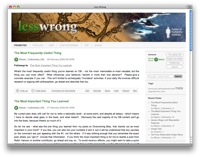
Since starting my new job at Tricycle Developments in January I've been working on a project to repurpose the Reddit source code into a kind of community blogging platform with voting and karma.

The result of that work went live on Thursday and after an initial hiccup with a questionably named user posting off topic content its going well so far. One of the first posts on the site is one asking for feedback on Issues, Bugs, and Requested Features. The thread has been inundated with all three of these so it looks like I still have plenty of work ahead refining the user experience.

As well as being the first site I've worked on from start to finish (aside from personal ones) Less Wrong is also my first Python project and significant open source project. Its been great learning another programming language and putting that knowledge into practice. You can check it out the code on GitHub (pun not intended). Also if you end up looking at or using the code or Less Wrong itself and encounter any issues there is an issue tracker on Google Code where they can be logged.

Related Posts

Comments (3) Trackbacks (0)
  1. I must say that I’m surprised that there are 238 comments in the linked post on Less Wrong but none on your personal post for making the site public.

    My intuition to suspect that others on lesswrong would answer the questions of “Who maintains and modifies this site?” and “How best may I contact them with suggestions for changes?” would lead them to click on the “About” page, follow through to GitHub, find the maintaining user, go to their URL, and comment on a relevant post at a frequency greater than 1% seems to be mistaken.

    I’ve dissected this by finding the other paths to relevant places to make suggestions (google code or the mentioned lesswrong post) and think this may be the result of most of the people who have seen lesswrong so far having been exposed to the post requesting bug reports through the front page before having to ask themselves the above questions. I’m posting this here sort of as an experiment, so I hope that anyone else who makes it here also posts the logical steps they followed in getting to your post and reading this comment.

    Normally my intuitive estimation of utility for going to the effort of thinking over my surprise at apparent miscalculation of a non-issue wouldn’t lead me to go to the lengths of writing this out, but I’m considering this a novel application of testing my rationality (http://lesswrong.com/lw/h/test_your_rationality/). If I didn’t state the following, I would also have the ulterior motive of hoping to establish a dialogue with the developer by commenting on his blog as opposed to following through to the links he provided on the blog post and posting my suggestion there.

    If my intuitive calculation was accurate, the number of comments with suggestions here should eventually break a 1:100 ratio against comments on the lesswrong issues post (though more accurately I should be comparing the number of commenters with suggestions here to the number of commenters with suggestions there).

    To be pragmatic, I need to consider all the apparent variables affecting decision pathways for persons looking to suggest changes to the lesswrong code-base. The first variable I can note is that the link to the about page on lesswrong is above the fold on every page (http://www.viget.com/inspire/evolving-design-standards-the-fold/), whereas the link to the issues post is at the bottom of every page. Finding and clicking one link over the other when attempting to answer my query could also be affected by an experiential heuristic for suspecting that an “about” page is most often the best place to find technical information about a site.

    For more clues, I traced my path and found that I followed the first visible relevant reference to my query of “Contact who for change suggestion?” going from the home page of lesswrong. The path I followed seems to have included more steps than any of the other possible solutions though. To explain this, I analyze why I might have clicked on the GitHub link on the about page before reading the rest of the paragraph that contained it and finding the Google Code issue tracker link. I suspect that I’m prone to quickly following links when I expect they’ll provide more relevant information than what I’m currently reading, and perhaps much more so than average. I knew that GitHub would allow me to access detailed information about the code-base maintainer(s), but I can’t accurately estimate the proportion of people on lesswrong who would share that knowledge. Out of the total set of lesswrong readers, I do expect that there’s a strong correlation between knowledge of GitHub functionality and coming to query lesswrong for information about how to affect change to its code-base though.

    Now assuming anyone else with my query got to this post before becoming satisfied with finding the Google Code issue tracker or the Issues post on lesswrong, what might possess them to post the suggestion here instead of following the links on this post? I hold as knowledge from experience and from accounts of acquaintances that the most personal relevant means of contacting a person available is generally the most effective at illiciting a response, but I can’t estimate with any confidence the commonality of that knowledge within the lesswrong reader base or by extension the motivation to act on that knowledge.

    Having torn the problem to pieces and finding various points along decision pathways that could lead to the action I’ve taken where I have a high-degree of uncertainty (not to mention the possibility that I’m an outlier experiencing an observation selection effect), I have to update my initial probability estimate to be a wide confidence interval. I may update this with explicit calculations, but for now I’ll say that given the above analysis I feel 90% confident that the proportion of lesswrong readers who will query how to affect its codebase and decide to post here as opposed to in another relevant place is greater than .1% but less than 1%, ceteris paribus. By posting this, I’m likely positively affecting that ratio, and other confounding events such as someone taking note of this comment and making the lesswrong community at large (or at least a portion of the community that is not querying how to contact the site’s maintainer) aware of it could also affect this, so I guess I’ll have to see.

    Now to my suggestion: I have been mildly frustrated with the lack of comment threading on OB and today had an idea that would allow logical connections to previous posts without forcing the user community to change their posting style. I’ve observed that most users when replying to another’s post will say “@user:” (probably largely adopted from Twitter) this convention could be parsed client-side to create a popup including that user’s previous comments on the post when you hover over “@user” This would allow replying to multiple comments, as is often done, without having to create threads or reply to multiple threads. In looking at the comments on LessWrong so far, I’ve not seen any use of “@user” but wonder if the introduction of threading was the best solution. Aesthetically, I like the nested boxes, but wonder whether OB’s lack of logical comment flow and reported difficulties with logical flow of threading in lesswrong (http://code.google.com/p/lesswrong/issues/detail?id=115) could be solved with a common solution as I’ve proposed. To avoid being a theoretical bikeshed painter (http://www.codinghorror.com/blog/archives/000922.html), I’d be willing to try writing this feature up as a greasemonkey script with sufficient interest (though embedded javascript seems like the best solution were this to be implemented).

    P.S. Wesley, hi! Feel like making a bet against my estimate?

  2. Hi Wesley, I’m just starting to work on a reddit clone. Yours is simply spectacular. I just got to the point of getting the site up through their installation instructions, although there’s an occasional exception.

    I’m finding that making changes like adding new fields to the Submit Link page and modifying the code to be quite difficult because there are many parts and no real documentation. Can you share some insight on what hurdles you overcame when making lesswrong? How have you been working with the code?

  3. Jeff, to get my head around the code I suppose I just started making the changes I needed to and learnt along the way. It is difficult at times to work out how it fits together but it does make sense after a while. Initially I was pairing with another developer so we would basically try to work out how it worked together, each helping one another.

    If I get the time I might try to do a post on how a particular series of requests gets rendered.


Leave a comment


Trackbacks are disabled.

Recent Comments

Categories

Links

Archives

Tags

adaptive atom awk bash benchmark books cake consolas core-audio debian decoder delivery expand feed font fonts git glob gripe installer iPhone ipod Linux mad melbourne microsoft mp3 mpg123 music package pocket-reference rss ruby script sed shell smoothing snow-leopard textmate title tux UNIX uri-scheme variable virtualbox

Meta

Contact